
Precision Cancer Care — Where Every Treatment Begins with Understanding the Patient.
A cancer diagnosis does not just raise medical questions — it raises human ones. Is this treatment the right one? Am I being told everything I need to know? Is there a better option I have not heard of? Will the person treating me actually have the time to explain?
Spashta Healthcare was built in part to answer exactly these questions. Our medical oncology practice, led by Dr. Sneha Kommineni, brings together precision diagnostics, personalised treatment, and the time needed for the kind of conversation a cancer journey actually requires — within a neighbourhood clinic in BTM Layout, off Bannerghatta Road.
Dr. Sneha Kommineni is a Consultant Medical Oncologist (MBBS, MD, DNB — Medical Oncology, MRCP SCE UK) with particular expertise in targeted therapy for solid and haematological malignancies. She completed her MBBS at Siddhartha Medical College, Vijayawada, her MD at Pramukhswami Medical College under Sardar Patel University, Gujarat, and holds the Specialty Certificate Examination (SCE) from the Royal College of Physicians, UK.
In addition to her practice at Spashta Healthcare, Dr. Sneha is available for consultations by prior appointment at Aster RV and Aster Whitefield.
Her clinical philosophy is built around three convictions: every cancer is different, every treatment should be shaped by that difference, and the quality of life a patient lives during and after treatment matters as much as the treatment itself. She is known among her patients for the depth of her explanations, her willingness to sit through difficult conversations without rushing, and her insistence on making sure every treatment decision is understood — not just accepted.
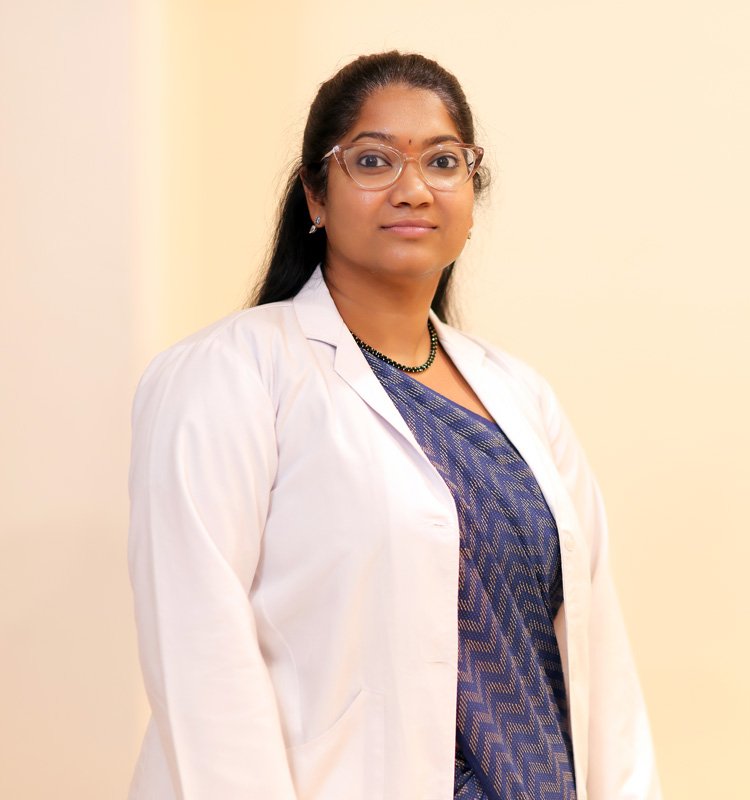
Consultant Medical Oncologist MBBS, MD, DNB (Medical Oncology), MRCP SCE (UK)
Siddhartha Medical College, Vijayawada
Pramukhswami Medical College, Sardar Patel University, Gujarat
Medical Oncology
Royal College of Physicians, United Kingdom
Targeted Therapy for Solid and Haematological Malignancies
Aster RV and Aster Whitefield, Bengaluru
The way cancer is treated has changed fundamentally in the last decade. Where oncologists once chose therapies based primarily on the type and stage of cancer, today effective treatment decisions are driven by the molecular and genetic profile of the tumour itself. Two patients with what appears to be the same cancer on a scan may, at the molecular level, have two entirely different diseases — and they deserve two entirely different treatment plans.
Dr. Sneha practises this precision-led approach as the foundation of her oncology care, not as an add-on.
Genetic and molecular testing of the tumour itself reveals the specific mutations driving that patient's cancer. This information is used to identify which targeted therapies are likely to work, which are unlikely to help, and which clinical trials the patient may be eligible for. Dr. Sneha incorporates tumour genomic profiling into routine care wherever it is clinically meaningful.
Next-generation sequencing is a comprehensive genomic analysis that reads large sections of the tumour's DNA in a single test, identifying actionable mutations and resistance markers that conventional testing would miss. For complex cancers, rare cancers, and cases where the first line of treatment has not worked, NGS can often reveal a path forward that would otherwise have been missed.
A liquid biopsy is a blood test that detects fragments of tumour DNA circulating in the bloodstream. It can be used to identify mutations, track how the cancer is responding to treatment, and pick up early signs of recurrence — often before any change is visible on a scan. For patients where a tissue biopsy is not feasible or is difficult to repeat, liquid biopsy offers a powerful alternative.
Molecular reports are only as useful as the interpretation placed around them. Before Dr. Sneha finalises a treatment plan based on genomic data, she ensures the findings are reviewed in a multidisciplinary context — integrating the pathologist's perspective, radiology, surgical oncology, and radiation oncology inputs where relevant. The test result becomes a clinical decision only after it has been situated in the full picture of the patient.
Two patients with the same cancer on a scan can have two completely different diseases at the molecular level. Precision oncology — using genomic profiling, NGS, and liquid biopsy — is the difference between a treatment aimed at the disease and a treatment aimed at your disease.
Once the diagnosis and molecular profile are clear, Dr. Sneha builds a treatment plan that is specific to the patient — not just the cancer. That plan may draw on one or more of the following therapies, often in combination, and always with the patient’s overall health, preferences, and life circumstances considered.
Chemotherapy remains a foundational tool in cancer treatment, and for many cancers it is still an effective option. Dr. Sneha administers both oral chemotherapy (tablet-based regimens that can often be taken at home) and intravenous chemotherapy (infusion-based treatments) with proactive management of side effects — because modern chemotherapy is not the brutal experience it used to be, when it is planned well and supported carefully.
Targeted therapies are drugs designed to act on specific molecular features of a cancer — the mutations, proteins, or pathways that drive that particular tumour. Because they are aimed precisely at what is fuelling the cancer, they often produce strong results with less damage to healthy tissue. Dr. Sneha prescribes targeted therapy for both solid tumours and haematological malignancies based on molecular findings.
Immunotherapy works differently from every treatment that came before it. Rather than attacking the cancer directly, it trains the patient's own immune system to recognise and destroy cancer cells. For certain cancers, immunotherapy has transformed outcomes that were once considered grim. Dr. Sneha offers immunotherapy where it is clinically appropriate and supported by the patient's molecular profile.
An important decision in a cancer journey is rarely any single drug — it is the overall plan. How to sequence treatments. Which therapies to combine. When to pause. When to switch. How to balance effectiveness with side effects. Dr. Sneha's treatment plans are built collaboratively with the patient, with careful attention to both clinical evidence and individual life context.
The easiest cancer to treat is the one that is prevented, or caught so early that a full cure is possible. Prevention and early detection are not secondary concerns in Dr. Sneha’s practice; they are a core clinical focus.
Not every person needs every screening test, and not every screening should begin at the same age. Dr. Sneha recommends structured cancer screening programmes based on age, gender, family history, and personal risk factors — covering breast, cervical, colorectal, and other common cancers — ensuring that screening is both adequate and appropriate.
Some effective cancer prevention tools available today are vaccines. The HPV vaccine significantly reduces the risk of cervical, throat, and several other cancers. The Hepatitis B vaccine reduces the risk of liver cancer. Dr. Sneha advocates preventive vaccination strongly — especially among younger adults and families — because the evidence for these vaccines is overwhelming, and the uptake in India remains far below what it should be.
Some cancers run in families — not because of bad luck, but because of identifiable inherited genetic mutations. Hereditary cancer gene testing (for BRCA1/2, Lynch syndrome, and other hereditary cancer syndromes) can identify individuals at elevated risk long before any cancer develops, enabling enhanced surveillance, preventive intervention, and informed decisions for the whole family. Dr. Sneha guides patients and families through hereditary cancer testing with careful counselling before and after.
As part of the upcoming upgrade to the practice, Dr. Sneha plans to introduce blood-based early detection assays — tests that look for early molecular signals of cancer from a simple blood draw, even before symptoms or imaging changes appear. This is an important emerging area in cancer prevention globally, and Spashta is preparing to bring it into routine clinical access.
For many patients, the end of active treatment is not the end of the cancer journey. It is the start of a new phase — one that can bring its own uncertainties, physical changes, and emotional complexity. Dr. Sneha is known for the depth with which she attends to this phase of care, which is too often treated as an afterthought.
Cancer treatments can leave behind long-term effects — on the heart, kidneys, nerves, bones, hormones, or fertility — that need structured monitoring long after the last dose is given. Dr. Sneha builds toxicity surveillance into every survivorship plan, catching problems early and managing them proactively.
For high-risk patients, structured follow-up is essential for catching any recurrence at the earliest stage, when it is easier to treat. Dr. Sneha uses imaging, biomarker monitoring, and where appropriate, ctDNA-based minimal residual disease monitoring — technology that can detect returning cancer at the molecular level, often well before it would be visible on a scan.
Returning to normal after cancer is rarely a straight line. It involves physical rebuilding, emotional reconstruction, and often a reassessment of priorities. Dr. Sneha supports patients through structured lifestyle modification — nutrition, activity, sleep, stress — as a clinical part of recovery, not an optional extra.
Anxiety, low mood, fear of recurrence, and survivor guilt are common and real. They are not signs of weakness. Dr. Sneha addresses the psychological dimension of survivorship openly — and where specialist support is needed, connects patients with appropriate counselling and peer support.
Palliative care is not end-of-life care. It is the discipline of managing pain, symptoms, and quality of life alongside active treatment, from the point of diagnosis onwards. Dr. Sneha integrates palliative and supportive care into every treatment plan where it is relevant — because no patient should be asked to endure pain or discomfort that modern medicine can relieve.
For long-term cancer survivors, a second, unrelated cancer can develop years after the first — sometimes as a late effect of earlier treatment. Dr. Sneha has specific expertise in planning treatment for second cancers in survivors, where prior therapy history, accumulated toxicity, and long-term effects all have to be carefully factored into the new plan.
Many patients come to Dr. Sneha not because they are newly diagnosed, but because they are already on treatment and want to know one thing: is this the right plan?
This is a reasonable, intelligent question, and Dr. Sneha takes it seriously. She reviews prior reports, imaging, and treatment history in detail, and offers a clear, honest assessment — whether that confirms the current plan, suggests a refinement, or identifies a meaningfully different option. Her goal is never to override another clinician; it is to make sure the patient is on a path they understand and can trust.
Cancer is rarely an individual diagnosis. Spouses, children, parents, and siblings carry the weight of the journey alongside the patient — and they often need guidance of their own. Dr. Sneha includes family members in treatment conversations where the patient wishes, offers structured support for caregivers, and participates in community educational activities and support groups — including women-for-women initiatives that have become an important part of her practice.
Precision oncology means choosing cancer treatment based on the specific molecular and genetic profile of a tumour, rather than only on its type and stage. Two patients with what looks like the same cancer can respond very differently to the same drug, depending on the mutations driving their disease. Precision oncology is the difference between a treatment aimed at the disease and one aimed at your disease.
Chemotherapy is a broad treatment that attacks rapidly dividing cells. Targeted therapy is aimed precisely at the molecular features driving a specific cancer — so it tends to affect cancer cells more and healthy cells less. Immunotherapy works by training the patient’s own immune system to attack the cancer. Modern treatment plans often combine these approaches rather than choosing one.
Yes — and this is one of the most common reasons patients come to her. Dr. Sneha reviews your prior reports, imaging, and treatment details, and provides a clear, honest assessment of the current plan and any alternative options. The goal is to give you confidence in your path, whatever that path looks like.
A regular biopsy involves taking a tissue sample, usually through a needle or a surgical procedure. A liquid biopsy is a blood test that detects fragments of tumour DNA circulating in the bloodstream — no tissue needed. It is useful for identifying mutations, monitoring treatment response, and detecting early signs of recurrence, often before any change appears on a scan.
It is worth considering if you have a strong family history of cancer — especially breast, ovarian, colorectal, or uterine cancer — or if cancers in your family developed at unusually young ages. Dr. Sneha will take a detailed family history and advise whether testing is clinically appropriate, with proper counselling before and after.
HPV vaccination is most effective when given before sexual activity begins, but it can still offer meaningful protection in adults — particularly young adults up to the mid-forties, and in certain clinical situations beyond that. Dr. Sneha will advise based on your age, exposure history, and current health.
Spashta Healthcare is a super speciality OPD clinic for consultation, treatment planning, follow-up, and survivorship care. Intravenous chemotherapy infusions, advanced imaging, surgery, and radiation therapy happen at partner hospital settings, where Dr. Sneha coordinates your care fully. Many patients find it significantly easier to have their ongoing consultations and oral therapy follow-ups at the neighbourhood clinic, with hospital visits reserved only for specific interventions.
A first consultation is unhurried. Dr. Sneha reviews your history, any prior reports and scans, your family history, and your personal concerns. She explains what is known, what is still unclear, what tests may be needed next, and what the likely treatment paths are. You will not be rushed, and you will not leave with unanswered questions.
Our oncology clinic is in BTM Layout, off Bannerghatta Road. It is easy to reach from HSR Layout, Jayanagar, JP Nagar, Koramangala, Bommanahalli, Hongasandra, Bilekahalli, Hulimavu, Arekere and Sarjapur Road, and from across South and Central Bengaluru.
Evening and off-hours appointments are available, because cancer conversations should not be squeezed into a working lunch break. You get the time, the attention, and the clinical depth that a cancer journey actually needs.
WhatsApp us