
Walk In. No Wait. No Compromise.
At Spashta Healthcare, you can see a heart specialist close to home. There is no long wait and no big hospital queue.
Dr. Praneeth Suryadevara treats everything from simple heart check-ups to complex procedures such as angioplasty, valve replacement and pacemakers.
Dr. Praneeth Suryadevara is a Consultant Interventional Cardiologist (MD, DM). He trained at Sri Jayadeva Institute of Cardiology, Bengaluru. He completed his MD in General Medicine at Andhra Medical College, Visakhapatnam, and his MBBS at Rangaraya Medical College, Kakinada.
Along with his clinic at Spashta Healthcare, he performs heart procedures at Apollo Hospitals, Bannerghatta Road. His work covers angioplasty, valve procedures, heart rhythm problems and preventing sudden cardiac death.
He believes in finding heart disease early and explaining things clearly, because informed patients do better. He has also led CPR training programmes in South Bengaluru.
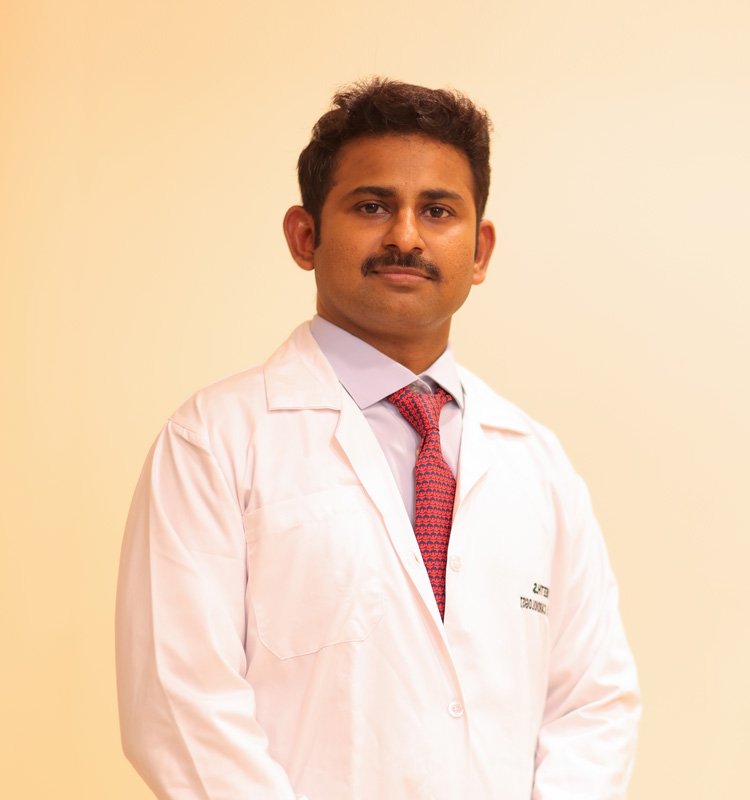
Dr. Praneeth Suryadevara
Consultant Interventional Cardiologist MD, DM (Cardiology)
Sri Jayadeva Institute of Cardiology, Bengaluru
Andhra Medical College, Visakhapatnam
Rangaraya Medical College, Kakinada
Interventional Cardiology | Structural Heart Interventions | Complex Coronary Angioplasty
Apollo Hospitals, Bannerghatta Road, Bengaluru
Angioplasty is a procedure to open blocked heart arteries. Dr. Praneeth offers several modern ways to do it.
In regular angioplasty, a metal stent is left in the artery. In stentless angioplasty, a drug-coated balloon opens the artery and nothing is left behind. This can help people with smaller arteries, or those worried about long-term stent problems. Dr. Praneeth's team has more than three years of experience with this method.
Sometimes a stent is needed. A bioresorbable stent holds the artery open while it heals and then slowly dissolves. No permanent metal stays in the body. It is not available at every centre.
Doctors usually guide angioplasty with X-ray pictures of the artery. IVUS and OCT use a tiny camera inside the artery for a clear, close-up view. This helps measure the artery, see the blockage and place the stent or balloon with care. The result is fewer complications and a lower chance of the blockage coming back.
In a heart attack, every minute counts. Primary angioplasty quickly opens the blocked artery to save heart muscle. Dr. Praneeth performs this procedure at Apollo Hospitals.
Some arteries stay fully blocked for months or years. These are called chronic total occlusions, and they are hard to treat. Dr. Praneeth treats these and other complex blockages, such as many blocked vessels, calcium build-up and blockages at a branch of the artery.
Some patients have a very weak heart but still need angioplasty. A pump such as an IABP or an Impella supports the heart during the procedure. This makes treatment possible for patients who would otherwise be too risky to treat.
An angiogram is a test that shows blockages in the heart arteries. Dr. Praneeth keeps the radiation and dye as low as possible and explains the results and your options clearly.
If you have been told you need a stent, you can ask whether stentless angioplasty is an option for you. A detailed check-up and your scans will show if it suits your case.
Structural heart disease means a problem with the heart’s valves, walls or chambers. Many of these problems once needed open-heart surgery. Today many can be treated through a thin tube (catheter), without opening the chest.
TAVI replaces a narrowed aortic valve without open-heart surgery. A new valve is passed through a tube from the leg and starts working at once. Recovery is much faster. It can help older patients and those who may not be fit for surgery. Dr. Praneeth checks your heart with scans, chooses the valve size and plans the procedure with the team at Apollo Hospitals.
Aortic stenosis needs care over many years, not just one procedure. The valve you choose today should still make sense when you are in your seventies or eighties. Dr. Praneeth plans ahead, including a possible future valve-in-valve procedure, and checks the valve regularly with the right scans.
TMVR replaces a damaged mitral valve through a tube, without open surgery. It is meant for selected patients who cannot have regular surgery. Dr. Praneeth reviews each case carefully with other specialists.
A PFO or ASD is a small hole in the wall between the upper chambers of the heart. Some people are born with it. In young adults it can sometimes be linked to a stroke. The hole can be closed with a small device passed through a tube, with no surgical cut.
This test measures the pressure inside the heart chambers and blood vessels. It helps to diagnose and plan treatment in complex heart problems, including heart failure and before structural procedures.
The heart also works on electrical signals. When these signals go wrong, you may feel palpitations or, in serious cases, have a sudden cardiac arrest. Dr. Praneeth treats rhythm problems and helps prevent sudden cardiac death.
A pacemaker helps when the heart beats too slowly or the signals are delayed. Dr. Praneeth chooses the right device, sets it up and follows you up over the years.
A leadless pacemaker is a tiny capsule placed inside the heart through a tube. There is no cut in the chest, no wires and no bump under the skin. For the right patient it is less invasive and avoids problems linked to wires.
A regular pacemaker sends signals from the tip of the right chamber. Physiological pacing, such as His bundle or left bundle branch pacing, follows the heart's natural pathway. This gives a more natural heartbeat and helps protect heart function over time.
An ICD is a device for people at high risk of sudden cardiac arrest. It watches the heart all the time and gives a shock if a dangerous rhythm starts. Dr. Praneeth checks who needs one and looks after the device and the follow-ups.
Atrial fibrillation (AF) is a common heart rhythm problem and a major cause of stroke. Dr. Praneeth looks at rhythm control, heart rate and stroke prevention with blood thinners. When needed, treatments such as catheter ablation and left atrial appendage closure are options.
Renal denervation is for people whose blood pressure stays high even with several medicines. A catheter is used to calm the nerve signals between the kidneys and the brain. It is a newer option for carefully chosen patients.
Many heart visits do not start with a big procedure. They start with a symptom, a question or a routine check. Spashta Healthcare is made for these visits.
Many people have warning signs days or weeks before a heart attack and put them down to stress or gas. Dr. Praneeth looks for these signs in people at risk. After a heart attack, he guides your recovery and works to stop it from happening again.
Heart failure does not mean the heart has stopped. It means the heart is not pumping as well as it should. Dr. Praneeth uses scans, blood tests and the right medicines to keep you out of hospital and help you feel better day to day.
High blood pressure is common in Indian cities and is often ignored. If yours stays high despite treatment, Dr. Praneeth looks deeper. This includes 24-hour monitoring, checks for other causes and checks for damage to organs. In some cases he may suggest renal denervation.
Spashta Healthcare is a specialist clinic for check-ups and assessments. These heart tests are available on site, so you can often finish everything in one visit. For advanced scans, angiograms or procedures, Dr. Praneeth arranges them at Apollo Hospitals, so your care continues without a break.
Checks your heart rhythm and electrical activity.
An ultrasound that shows how the heart is built and how it works.
Shows how your heart responds when you exercise.
Checks your blood pressure and your risk of heart disease.
Looks at your risk factors, such as sugar, cholesterol, blood pressure and family history.
You can see Dr. Praneeth if you have a heart problem now, if you are managing a known condition, or if you just want to plan ahead for your heart health.
Stentless angioplasty uses a drug-coated balloon to open a blocked artery without leaving a metal stent behind. It suits some patients, such as those with smaller arteries or certain types of blockage. The only way to know is a check-up and a review of your scans.
A regular drug-coated stent is a metal frame that stays in the artery for life. A bioresorbable stent supports the artery while it heals and then slowly dissolves. It is a newer option.
TAVI replaces the aortic valve through a tube, usually from the leg. There is no chest opening and no heart-lung machine, and recovery is faster than after surgery. For older patients and those with other health problems, TAVI is often considered the better choice.
A leadless pacemaker is a tiny capsule placed inside the heart through a tube. There is no chest cut, no wires and no bump under the skin. For suitable patients it avoids many long-term problems of wired pacemakers. Whether it suits you depends on your pacing needs and your heart anatomy.
A regular pacemaker sends signals from the tip of the right chamber. Physiological pacing, such as His bundle or left bundle branch pacing, follows the heart’s natural pathway. This gives a more natural heartbeat and helps protect heart function over time.
No. Usually, consultations, follow-ups and basic tests happen at the clinic. You only go to Apollo Hospitals for a procedure, advanced scans or admission, and Dr. Praneeth arranges that for you.
No referral is needed. You can walk in or book on WhatsApp.
Yes. Many of his patients find this easier. Routine visits, medicine reviews and follow-up tests can happen at Spashta. You only go to the hospital for procedures or advanced scans.
Yes. Checking early works better than treating late. If you are over 35, or you have diabetes, high blood pressure, obesity, a smoking habit or a family history of heart disease, a heart check-up at Spashta is a good idea.
Looking for a heart specialist near HSR Layout, Jayanagar, JP Nagar, Koramangala, Bommanahalli, Hongasandra, Bilekahalli, Hulimavu, Arekere and Sarjapur Road? Spashta Healthcare is in BTM Layout, off Bannerghatta Road, and easy to reach from all of these areas and the rest of South and Central Bengaluru.
Morning and evening appointments are available. No referral is needed, so you can walk in or book on WhatsApp.
WhatsApp us