
Hormones Explained. Conditions Managed. Lives Restored.
Hormones work quietly in the background, but they affect almost everything in the body. They determine how you sleep, how you think, how you feel, how your body stores or burns fuel, how you grow as a child, and how you age as an adult. When one hormonal system goes out of balance, the effects are rarely limited to a single symptom — they show up as fatigue, weight gain, low mood, menstrual changes, high blood pressure, poor sleep, or a dozen other things that can easily be dismissed as stress or lifestyle.
At Spashta Healthcare, endocrinology is not an afterthought. It is a full specialist practice, led by Dr. Varun Suryadevara — a Consultant Endocrinologist and Diabetologist practising in Bengaluru.
Dr. Varun Suryadevara is a Consultant Endocrinologist and Diabetologist (MD, DM) with training from two major medical institutions in India. He completed his DM in Endocrinology from JIPMER, Puducherry, his MD in Internal Medicine from PGIMER, Chandigarh, and his MBBS from Rangaraya Medical College, Kakinada.
In addition to his OPD practice at Spashta Healthcare, Dr. Varun is available for consultations by prior appointment at Apollo Hospitals, Bannerghatta Road.
His clinical focus spans the full spectrum of endocrine and metabolic disorders — from the most common conditions like diabetes and thyroid disease, to complex adrenal and pituitary disorders, to paediatric endocrinology and growth and puberty concerns. What sets his approach apart is the insistence on treating the root cause rather than only the number on a report. A high TSH or a high HbA1c is not the disease — it is a signal pointing towards one. His practice is built around understanding what that signal really means for each specific patient.
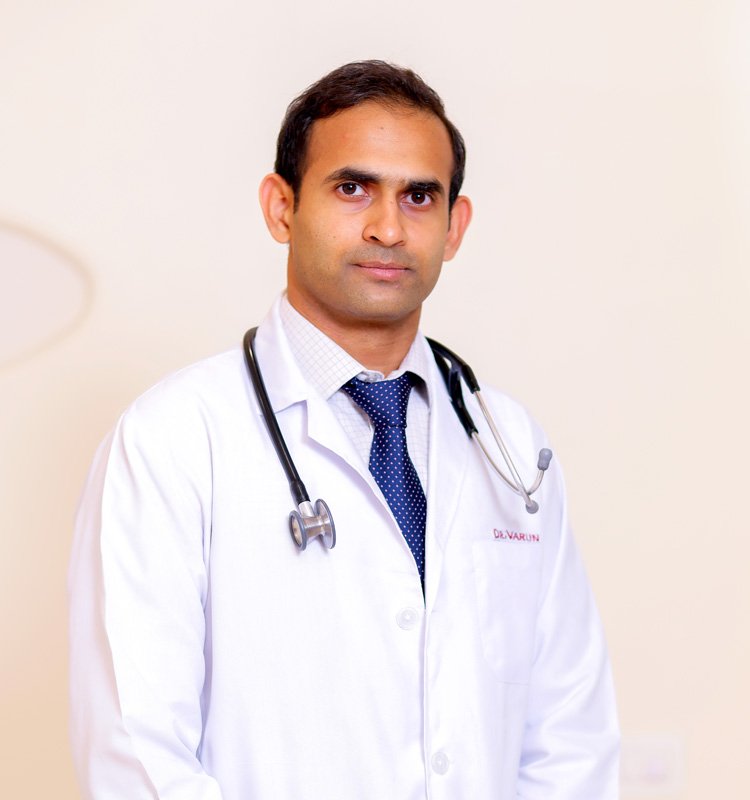
Consultant Endocrinologist & Diabetologist MD, DM (Endocrinology)
JIPMER, Puducherry
PGIMER, Chandigarh
Rangaraya Medical College, Kakinada
Diabetes (Type 1, Type 2, Gestational) | Thyroid Disorders | PCOS | Metabolic Disorders | Paediatric Endocrinology | Growth and Puberty Disorders
Apollo Hospitals, Bannerghatta Road, Bengaluru
India carries one of the highest diabetes burdens in the world, and Bengaluru is no exception. But diabetes is not a single disease with a single answer — it is a spectrum, and modern diabetes care reflects that. Dr. Varun’s approach is built on careful diagnosis, precise medication, and — where possible — structured reversal of early disease.
Type 2 diabetes is the most common form of diabetes, and also often misunderstood. For many patients, it is not simply a problem of high sugar — it is the end result of insulin resistance, metabolic stress, and lifestyle factors that have been building for years. Dr. Varun manages Type 2 diabetes using individualised medication protocols, continuous glucose monitoring where appropriate, and structured lifestyle intervention — with the goal of not just controlling numbers, but protecting the patient from the long-term complications that matter: heart disease, kidney disease, nerve damage, and vision loss.
For patients diagnosed early — particularly those with recent-onset diabetes and sufficient residual pancreatic function — Type 2 diabetes can often be sent into remission through a carefully structured combination of medication, nutrition, weight loss, and lifestyle change. Dr. Varun is experienced in identifying patients who are good candidates for reversal and guiding them through the process with regular monitoring and adjustment. This is not a miracle cure or a one-size-fits-all programme. It is evidence-based clinical reversal, done properly.
Type 1 diabetes is a lifelong autoimmune condition, most often diagnosed in childhood or young adulthood. It requires insulin therapy from day one, and benefits enormously from modern tools — continuous glucose monitoring, insulin pumps, and structured education. Dr. Varun provides comprehensive Type 1 diabetes care, including adolescent transition support, pregnancy planning, and long-term complication surveillance.
Diabetes that develops during pregnancy demands careful, coordinated management — both for the health of the mother and the long-term health of the baby. Dr. Varun works closely with obstetricians to manage gestational diabetes through monitoring, nutrition planning, and insulin therapy where needed, and follows up with mothers postpartum to assess their long-term diabetes risk.
CGM technology has transformed diabetes care — giving patients and clinicians a continuous picture of glucose patterns rather than a handful of finger-prick snapshots. Dr. Varun integrates CGM interpretation into routine care, using the data to fine-tune medication, meal timing, and lifestyle with a precision that was not possible even a decade ago.
The thyroid is a small gland with outsized influence. When it goes off balance — even subtly — the effects ripple through energy, mood, sleep, weight, skin, hair, and menstrual cycles. Thyroid disorders are also often missed in routine practice, because early symptoms are easy to dismiss.
When the thyroid gland produces too little hormone, the body slows down — weight gain, fatigue, cold sensitivity, low mood, constipation, and menstrual irregularities are common. Dr. Varun diagnoses hypothyroidism with careful clinical evaluation and appropriate testing, and tailors replacement therapy based on the individual — not just the TSH number. Dosing is adjusted over time to match the body's actual needs.
An overactive thyroid produces the opposite picture — weight loss, anxiety, tremors, heat intolerance, rapid heartbeat, and sleep disturbance. Dr. Varun diagnoses the underlying cause, whether Graves' disease, toxic nodules, or thyroiditis, and manages treatment through medication, radioactive iodine therapy, or surgical referral where appropriate.
Not every thyroid problem announces itself loudly. Dr. Varun is particularly careful about subclinical and borderline cases — patients whose TSH is slightly off, whose symptoms do not quite match the numbers, or who have thyroid nodules picked up incidentally on imaging. These patients benefit from specialist evaluation rather than reassurance alone.
PCOS is one of the most common hormonal conditions affecting women of reproductive age in India — and also one that is often poorly explained. It is not just a menstrual issue, and it is not just a fertility issue. PCOS is a whole-body metabolic and hormonal condition, with effects on insulin resistance, weight, skin, hair, cholesterol, and long-term diabetes and cardiovascular risk.
Dr. Varun approaches PCOS as the systemic condition it actually is. His treatment plans address insulin resistance, weight fluctuation, menstrual regulation, fertility concerns where relevant, and long-term metabolic health — with nutrition, targeted medication, and structured follow-up tuned to the patient's specific phenotype and life stage.
Weight is an emotionally charged topic in a clinic, and also one that is often reduced to unhelpful advice — eat less, move more. The reality is more complicated. Obesity frequently has hormonal and metabolic roots — insulin resistance, thyroid dysfunction, cortisol imbalance, genetic predisposition — and a plan that ignores those roots is usually a plan that fails.
Dr. Varun offers medically-guided weight management — identifying the hormonal and metabolic drivers of weight gain in each patient, addressing them specifically, and building a sustainable plan that combines appropriate medication, nutrition, physical activity, and where necessary, referral for advanced interventions. Sustainable, medically guided weight loss is possible, but it begins with understanding — not blame.
Patients are often given identical diet and exercise advice regardless of what is actually driving their weight gain. For some, the plan works. For many, it does not — and the failure is blamed on willpower. A proper endocrine assessment often reveals why the standard plan has not worked, and what kind of plan will.
Not all high blood pressure is the same. For most patients, hypertension has lifestyle and genetic contributors. But in a meaningful minority, the root cause is hormonal — an overactive adrenal gland producing too much aldosterone, a pheochromocytoma, thyroid imbalance, or Cushing’s syndrome. These cases will not respond fully to standard BP medication, and identifying them changes treatment completely.
Dr. Varun screens for endocrine causes of hypertension in patients whose BP is resistant to standard treatment, whose presentation is unusual, or who have other clinical signs pointing to a hormonal driver. Once identified, hormone-caused hypertension is targeted at its source — and the results are often dramatic.
The adrenal and pituitary glands are small, complex organs that regulate critical body functions — stress response, metabolism, blood pressure, reproduction, growth, and fluid balance. Disorders of these glands are relatively uncommon, but when they occur, they require specialist endocrinology expertise for proper diagnosis and management. Dr. Varun’s training at JIPMER and PGIMER includes dedicated exposure to complex adrenal and pituitary pathology.
Caused by excess cortisol — whether from an adrenal tumour, a pituitary tumour, or long-term steroid use — Cushing's syndrome produces weight gain, thinning skin, high blood pressure, diabetes, and muscle weakness. Dr. Varun diagnoses Cushing's through structured endocrine testing and coordinates surgical or medical treatment depending on the cause.
The opposite of Cushing's — too little cortisol. Addison's causes fatigue, weight loss, low blood pressure, and electrolyte imbalance, and in severe cases can be life-threatening. Dr. Varun manages Addison's with careful hormone replacement and structured patient education, including emergency protocols.
Pituitary tumours can either over-produce hormones (prolactin, growth hormone, ACTH) or suppress normal pituitary function. Dr. Varun evaluates patients with unexplained hormonal symptoms — infertility, abnormal lactation, changes in facial features, unexplained growth, loss of libido, visual changes — for pituitary causes, and manages treatment in coordination with neurosurgery and imaging specialists where indicated.
Osteoporosis is a silent disease. Bone density declines for years without symptoms, and the first sign is often a fracture that should not have happened. By that point, significant damage has already occurred. Postmenopausal women are at particular risk, but men and younger women with specific risk factors — steroid use, thyroid disease, early menopause, certain cancers — are often missed.
Dr. Varun assesses bone health through DEXA scans and targeted laboratory testing, and prescribes structured treatment — ranging from calcium and vitamin D optimisation to specific bone-strengthening medication — to preserve bone density and prevent fractures. The goal is not just to treat established osteoporosis; it is to catch declining bone health early, when it is still reversible.
Children’s growth and pubertal development follow predictable patterns — and when those patterns go off course, the cause is almost always hormonal. Growth and puberty disorders are a distinct and highly specialised area within endocrinology, and one where early recognition makes a lasting difference. What is diagnosed and treated in childhood determines adult height, bone health, fertility, and psychological wellbeing.
A child who is noticeably shorter than peers, whose growth velocity has slowed, or who is falling off their growth curve deserves a specialist evaluation rather than reassurance. The causes of short stature range from growth hormone deficiency and thyroid disease to nutritional, genetic, and systemic conditions. Dr. Varun assesses children with growth concerns through structured endocrine testing, bone age assessment, and where indicated, growth hormone therapy.
Delayed puberty — in girls and boys — can have both temporary and permanent causes. In some cases, it is constitutional and will correct itself with time. In others, it reflects an underlying hormonal condition that needs active treatment. Dr. Varun evaluates adolescents with delayed pubertal development to identify the cause, reassure where possible, and intervene where necessary — protecting both immediate wellbeing and long-term reproductive health.
When pubertal changes begin unusually early — before age 8 in girls or 9 in boys — the consequences include early bone maturation that can limit final adult height, and psychological challenges for a child developing ahead of peers. Precocious puberty requires specialist evaluation to identify the cause and, in many cases, medical treatment to slow the process until a more appropriate developmental age.
If you are unsure whether your child's growth or pubertal development is on track, it is always worth a specialist opinion. Early assessment is low-risk, often reassuring, and occasionally reveals conditions where early intervention changes the long-term outcome significantly.
A diabetologist focuses specifically on diabetes care. An endocrinologist is trained in the full range of hormonal disorders — including diabetes, thyroid, adrenal, pituitary, bone, and reproductive hormone conditions. Dr. Varun is both — which means he can manage diabetes in the context of the body’s full hormonal system, not in isolation.
For some patients — particularly those in the early stages of the disease with recent onset and reasonable pancreatic function — Type 2 diabetes can be sent into remission through a carefully structured combination of medication, nutrition, weight management, and lifestyle change. This is not a guaranteed outcome, and it requires significant commitment, but it is a real clinical possibility. Dr. Varun will assess whether you are a good candidate at your first consultation.
Possibly — and this is exactly the kind of case that benefits from a specialist look. Standard thyroid panels sometimes miss subtle patterns, and symptoms like fatigue can reflect other endocrine issues entirely — adrenal, pituitary, metabolic, or nutritional. A proper endocrine consultation is built for exactly these questions.
If your child is consistently shorter than peers, if their growth has slowed, or if they are falling behind on their growth curve, it is worth a specialist evaluation. Most cases turn out to be normal variations of growth, but some reveal hormonal conditions where early treatment changes final adult height significantly. The consultation is low-stakes; the potential benefit is long-term.
Ideally, both — for different aspects of care. PCOS is a hormonal and metabolic condition that extends far beyond the reproductive system, with long-term implications for diabetes, cardiovascular health, and weight. Dr. Varun’s role is to address the metabolic and endocrine dimensions comprehensively. For fertility planning specifically, coordination with a reproductive specialist is ideal.
Spashta Healthcare is a super speciality OPD and assessment clinic. Consultations, basic diagnostics, and follow-ups happen here. For advanced investigations or inpatient care, Dr. Varun coordinates seamlessly with his practice at Apollo Hospitals, Bannerghatta Road.
No referral is needed. You can simply walk in or book an appointment via WhatsApp.
Any recent lab reports, imaging, and a list of current medications. If you have a chronic condition, a summary of your clinical history is useful. If you are not sure what is relevant, bring everything — Dr. Varun prefers seeing the full picture.
Visit our diabetes and endocrinology clinic in BTM Layout, off Bannerghatta Road. It is easy to reach from HSR Layout, Jayanagar, JP Nagar, Koramangala, Bommanahalli, Hongasandra, Bilekahalli, Hulimavu, Arekere and Sarjapur Road, and from across South and Central Bengaluru.
Morning and evening appointments are available. No referral is needed. You can walk in or book on WhatsApp.
WhatsApp us